

By OCA Young Reporter Zaynab Kawtharani
Nagoya, Japan, October 2, 2026: One gold medal contest lasted more than six minutes. One bronze medal contest was over in 15 seconds. Between them, the women’s under 78kg judo competition at Aichi International Arena on Friday offered very different routes to the Asian Games podium.
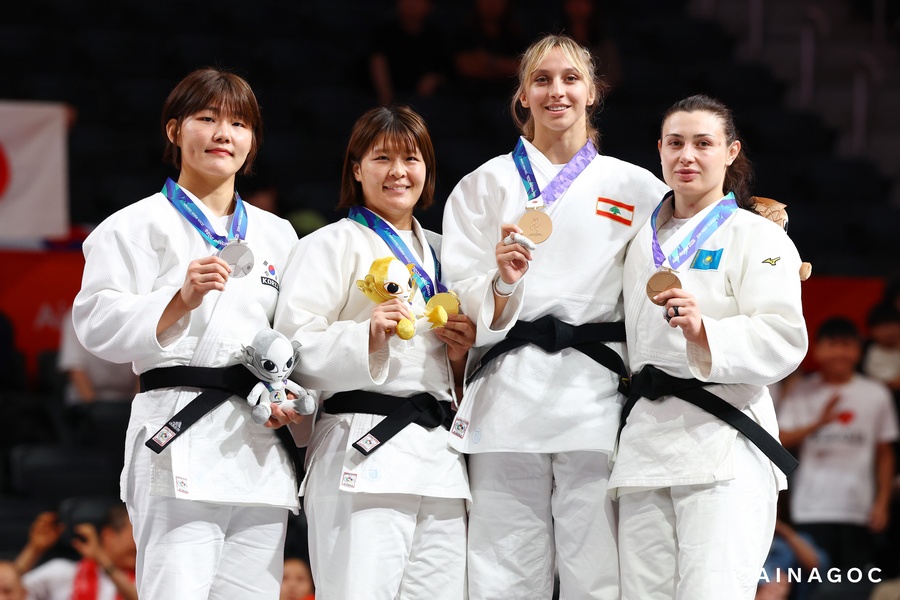
Japan’s Mizuki Sugimura emerged as champion after a tense final against Korea’s Kim Minju, while Kazakhstan’s Ekaterina Tokareva and Lebanon’s Aqulina Chayeb claimed the two bronze medals.
The final became a test of patience as neither Sugimura nor Kim registered a technical score. Both received an early shido, and the contest continued into golden score before Kim’s third penalty decided the outcome at 6:03. Sugimura, who had accumulated two penalties herself, secured gold for the host nation.
For Sugimura, victory brought relief after a disappointing result at another international tournament a month earlier had shaken her confidence.
“I’ve been practising every day for this tournament, so I’m very happy that I was able to connect it to this result of winning the championship,” she said.
“I was able to fight through to the end, and the feeling of relief was the biggest emotion.”
Sugimura had anticipated facing Kim in the final and expected opportunities to throw to be difficult to create. Her approach was to remain patient and keep working towards a decisive opening.
“I strongly resolved to just persevere to the end and ensure it led to a victory,” she said.
Despite taking the title, Sugimura acknowledged that she had struggled to turn her attacking movements into successful throws. She nevertheless welcomed improvements in her newaza, or groundwork, which helped her remain effective when her preferred techniques were unavailable.
For Kim, silver brought recognition but little immediate consolation. She had prepared with gold as her target and struggled to accept falling one step short.
“A silver medal is a really good result, but since I went through all the training with only the gold medal in mind I can’t help but feel disappointed,” she said.
The Korean judoka revealed that she had competed while managing an elbow injury sustained last November and a completely torn anterior cruciate ligament in her knee. She postponed surgery to take part in the Asian Games, relying on rehabilitation and strengthening work.
Kim said she experienced pain when kneeling, falling or twisting her knee during grappling. With Olympic qualification in mind, she intended to continue competing to improve her ranking, while remaining determined to challenge for gold at a future Olympics or Asian Games.
Kazakhstan’s Tokareva secured bronze against Iran’s Maryam Barbat, winning by waza ari. She registered one waza ari and two yukos, while Barbat finished without a technical score and received one shido.
The other bronze contest produced a swift finish. Chayeb needed just 15 seconds to defeat China’s Wu Hongtao by ippon, becoming the first female judoka representing Lebanon to win an Asian Games medal.
The 22-year-old had advanced from the round of 16 by fusen gachi, with Kyrgyzstan’s Aiganysh Daniiarovna Dzhumalieva listed as disqualified. She then defeated Chinese Taipei’s Hsu Wang Shu huei by waza ari over four minutes in the quarterfinals.
Kim halted her progress in the semifinals with two yukos over four minutes, but Chayeb returned to secure bronze.
“It is an incredible feeling, nothing compares,” Chayeb said.
Reflecting on her route to the podium, she identified mental focus as a decisive part of competition.
“I think the toughest battle is always the mental one,” she said.
Chayeb dedicated the medal to her parents, crediting their emotional and financial support and their belief in her from the beginning. She said her commitment to keeping Lebanon’s flag high remained central to her ambitions.
“My long term goal is definitely a medal in the Olympics,” she said, with Grand Slam, Grand Prix and World Championship medals among her nearer targets.