

By Ken Marantz
OCA Media
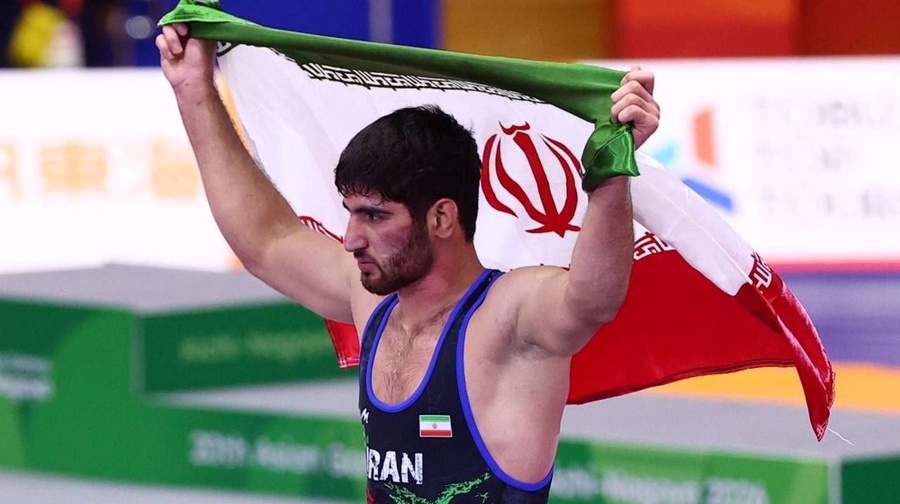
Nagoya, Japan, October 1, 2026: Iran’s Alireza Abdevali was spared by the draw of having to negotiate the mine field that Paris Olympic champion Nao Kusaka of Japan had en route to their clash in the Greco-Roman 77kg final.
But Kusaka concedes that had nothing to do with Abdevali’s 5-3 victory in the gold-medal match at Inae Sports Center on Thursday night, the second day of the wrestling competition at the Asian Games.
“I was weak,” a dejected Kusaka said. “I was beaten in the key situations that decided the match.”
In the two other finals that wrapped up the Greco competition, Kyrgyzstan’s Zholoman Sharshenbekov successfully defended his Asian Games crown at 60kg, while Japan’s Yuri Nakazato triumphed at 97kg to earn his first major international title and deny India its first Asian Games gold in Greco in 62 years.
In the 77kg final, Abdevali scored a takedown in the first period to lead 2-0, then the second period devolved into an exchange of stepouts as each tried to score big throws but had to settle for single points.
At one point, Kusaka pulled even at 3-3, although trailing on criteria, but Abdevali defended against the Japanese’s body locks and managed to force him out twice to clinch the victory.
“I practiced so hard and my coach prepared me to come here and get the gold medal,” said Abdevali, the world U20 champion in 2024. “I haven’t won a gold medal in a long time.”
Kusaka could not have encountered a rockier path to the final, as the match-ups in his first two bouts were worthy of a major global final—in fact, one was a rematch of the 2024 Asian Championships final and the other from the Paris Olympics.
First, Kusaka had to get past Kyrgyzstan rival and two-time former world champion Azkhol Makhmudov, the reigning Asian champion and Asian Games gold medalist three years ago.
When the two were drawn together on Tuesday, it drew gasps from the gathered team officials.
Kusaka had the first chance at par terre and, although he lifted Makhmudov into the air, he couldn’t complete a full throw. He was awarded a 2-point exposure, but that was wiped away in a challenge by the Kyrgyz side.
As the two battled for position, Makhmudov attempted a back suplex throw, but Kusaka stopped him midway and drove him on to his back. It turned bizarre from there, as Makhmudov, believing Kusaka had stepped out of the ring while executing his move, stopped fighting completely, allowing a fall to be called.
Again the Kyrgyz side challenged, but this time it was rejected, the fall confirmed and Kusaka awarded the victory.
In the quarterfinals, Kusaka gave up an early 4-point arm throw to Kazakhstan veteran Demeu Zhadrayev and trailed 9-4 in the second period, then launched a furious comeback, scoring seven points in the final minute to advance 11-9. Kusaka had defeated Zhadrayev, a four-time Asian medalist, 5-2 in the final in Paris.
Makhmudov shook off the loss to come back and take a bronze medal, scoring two nifty 4-point throws to defeat China’s Liu Rui by 9-0 technical superiority in 1:27. Qatar’s Iranian-born Shahin Badaghimofrad earned the other 77kg bronze.
*At 67kg, Paris Olympic bronze medalist and two-time former world champion Sharshenbekov put on a furious second-period rally against reigning Asian champion Alisher Ganiev of Uzbekistan to notch a 7-5 victory.
Ganiev used a 4-point arm throw to take a 5-0 lead in the first period. But it all fell apart for the 2025 world silver medalist when he started to run out of gas and Sharshenbekov began racking up points.
A takedown was followed by two successive stepouts—with a fleeing point tacked on to the second—to leave Sharshenbekov trailing 5-5 on criteria. With :27 left, he got behind off a front body lock for the winning takedown.
In the bronze-medal matches, Sajjad Albidhan, a two-time Asian medalist at 55kg, defeated Korea’s Kim Dahyun 6-4 to become the fourth Iraqi in history to earn an Asian Games medal and the first since 2010.
Japan’s Ayata Suzuki captured the other bronze and the second of his career, rallying with six points in the second period for a 7-4 victory over Iran’s Sajjad Abbaspour.
*At 97kg, Nakazato scored a stepout in the first period and a takedown in the second to defeat India’s two-time Asian medalist Nitesh 4-0, making him Japan’s second Greco gold medalist in Nagoya and the country’s heaviest ever in Greco at an Asian Games.
Nakazato, the 2025 Asian silver medalist, advanced to the final with a hard-fought 5-4 win over Iran’s two-time former Asian champion Mehdi Balihamzehdeh in the semifinals.
Balihamzehdeh came back to earn a bronze medal along with Mongolia’s Genkhuyag Ganbaatar.