


By Katie Speldewinde
OCA Youth Reporter from Sri Lanka.
Nagoya, Japan, October 1, 2026: Four Sri Lankan sprinters took their place among Asia’s leading athletes at the Aichi-Nagoya Asian Games.
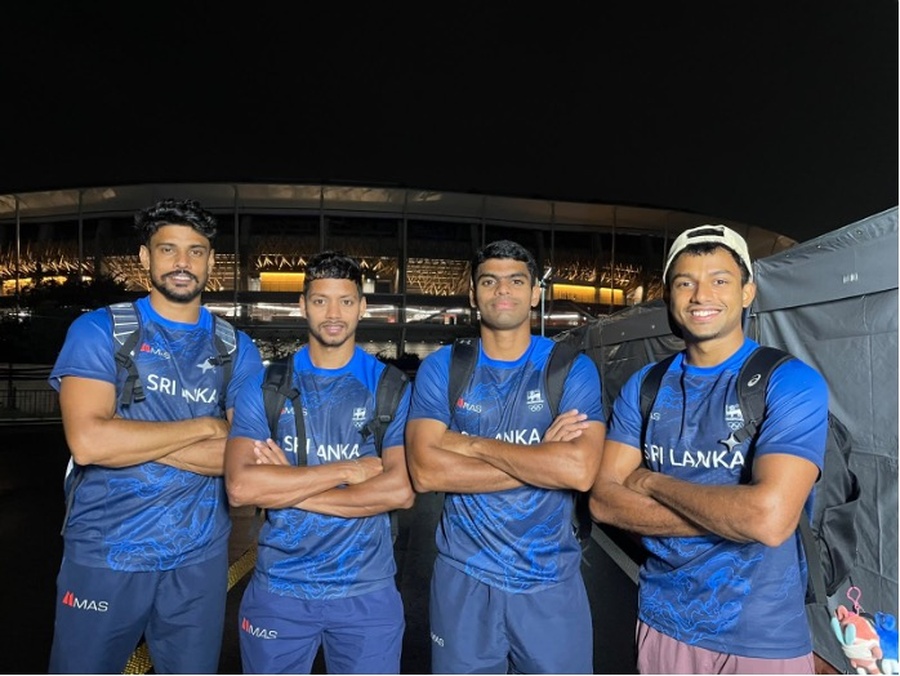
Dineth Weeraratna, Chamod Yodhasinghe, Merone Wijesinghe and Roshan Ranathunge represented Sri Lanka in the men’s 4x100m relay final, finishing seventh in 39.55 seconds and continuing a period of growing progress for Sri Lankan sprinting.
Their appearance in the final came only months after Sri Lanka established a new national record of 38.63 seconds in finishing fourth at the Asian Relays Championships in China - the first time a Sri Lankan men’s 4x100m relay team had broken the 39-second barrier.
That record provided an important indication of the progress being made by a new generation of Sri Lankan sprinters, while their performance at the Asian Games offered an opportunity to test that progress against the strongest relay teams on the continent.
In Nagoya, the team recorded 39.43 seconds in the heats before returning to the track for the final, where they competed against established sprinting nations in the championship race. Although the team finished seventh, the result formed part of a wider progression for the athletes, who have increasingly found themselves competing on the regional stage.
For the runners, however, the significance of the Asian Games extended beyond the time recorded on the scoreboard. Reflecting on the campaign, Wijesinghe said the team could take pride in the way it had performed and with the opportunity to compete together at one of Asia’s biggest sporting events.
“We are proud of the way we performed as a team. We gave everything we had and it was a great experience to compete at this level and represent Sri Lanka,” Wijesinghe said.
The athletes also spoke about wanting their performances to have an impact beyond their own careers, particularly among younger Sri Lankans who may be considering sport and athletics as a path of their own.
“We want young Sri Lankans to believe in sport and believe in athletics. If they see us representing Sri Lanka at this level, we hope it can give them the belief that they can do it too,” the athletes said.
That message is particularly relevant to a relay programme, where progress depends not only on individual speed but also on the development of a group of athletes capable of working together at the highest level. Each exchange requires precision, communication and trust, with fractions of a second capable of determining the difference between a clean changeover and a lost opportunity.
The progress of the individual athletes has also contributed to the team’s development. At the national selection trials in May, Weeraratna won the men’s 100m in 10.39 seconds, while Yodhasinghe recorded 10.48 seconds and Wijesinghe finished in 10.65 seconds, highlighting the depth emerging within Sri Lanka’s sprinting ranks.
The Asian Games final, therefore, represents more than a single result for the quartet. Coming after a national record earlier in the year, it gave the four athletes another opportunity to gain experience against Asia’s leading relay teams while establishing a new benchmark for those who will follow them.
For Weeraratna, Yodhasinghe, Wijesinghe and Ranathunge, the next stage will be about building on that experience, continuing to lower their times and developing the consistency required to compete at the highest level of Asian athletics. Their campaign in Nagoya has already placed them among a generation of Sri Lankan sprinters beginning to establish a stronger presence on the continental stage, while their message to the athletes watching from home may prove just as important: that there is a place for Sri Lanka in the future of Asian sprinting, and that the next generation can aim to be part of it.