


By Ken Marantz
Nagoya, Japan, September 29, 2026: With his second straight Asian Games gold already secured, Philippines pole vault star Ernest "EJ" Obiena thought he had one more good jump in him. It was all he needed.
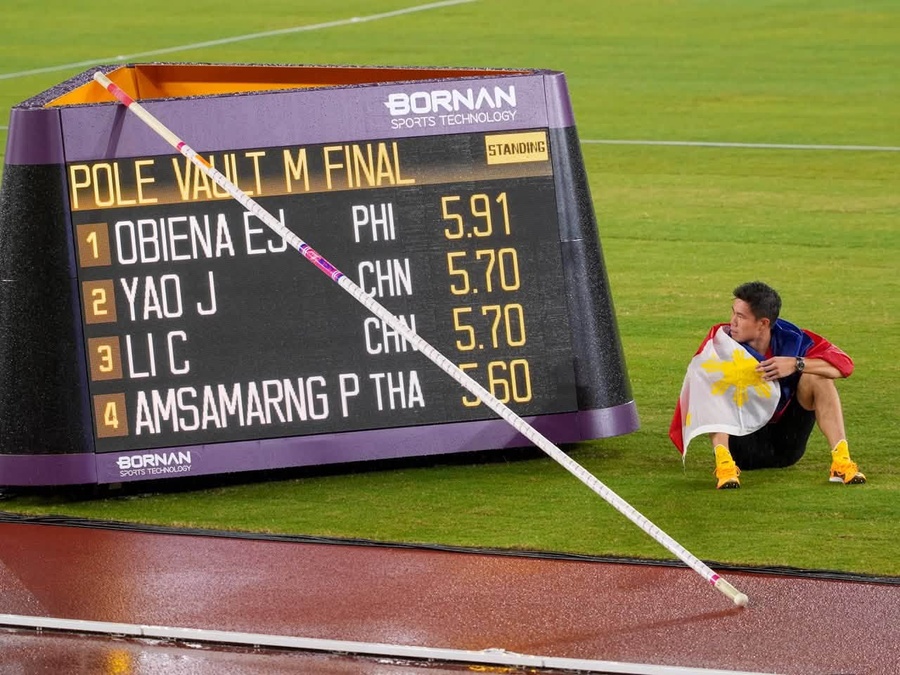
Obiena cleared 5.91 meters to take the gold on the final day of the athletics competition on a rainy Tuesday night, eclipsing by .01 the previous record he set three years ago in Hangzhou.
“I revel in this moment, I really enjoy it, I love the pressure,” said Obiena, a two-time world medalist who has put his country on the world athletics map. “I know I’m doing something significant.”
It was the second Asian Games record to fall among the three field events at Mizuho Park Athletics Stadium, with China’s Zhang Jiale also rewriting the Asian record in the women’s javelin with a throw of 78.27 meters.
The other field medal at stake went to Barnokhon Sayfullaeva, who gave Uzbekistan its fifth straight gold in the women’s high jump by clearing a personal best 1.90 meters.
Obiena, a four-time Asian champion, clinched the pole vault gold when he was the lone competitor to clear 5.75 meters and China’s Li Chenyang, who would take home the bronze medal, passed up to 5.80 but missed on his two attempts.
China’s Yao Jie was relegated to his second career Asian Games silver medal, tying with Li at 5.70 but finishing second ahead of him on fewer misses.
Obiena also missed twice at 5.80 but, with the gold in hand, had the bar raised to 5.91 for a single attempt at the meet record. He gracefully soared into the soggy night and over the bar without a hitch.
He then opted to call it a night and not take a shot at his Asian record of 6.00 that he set in August 2023 in Budapest.
“The conditions were not ideal, and I was cramping up, to be honest,” Obiena said.
“I could have gone 5.80, but I said to my coach, ‘I think I have one good jump left in my body,’
so I said I think I could jump .91. We went for it and I’m just happy to clear it.”
Obiena, who finished fourth at the 2024 Paris Olympics, gave the Philippines its third gold medal at these Asian Games in a sport in which the country has not traditionally been competitive, after the two won in gymnastics by Carlos Yulo.
“We’ve never had this many world-class athletes in such a small part of a generation,” Obiena said. “I’m happy to be part of it. It’s been a heck of a journey. I’ve done almost everything I’ve ever dreamed of as a kid. I’m just missing the Olympics.”
In the women’s hammer throw, Zhang uncorked her winning throw on her fourth attempt to not only relegate Chinese compatriot Zhao Jie to the silver medal, but also wrest the continental record from her.
She eclipsed by five centimeters the previous Asian mark of 78.22 meters that Zhao set in April this year in Chengdu. It also far exceeded the previous meet record of 77.33 set by fellow Chinese Zhang Wenxiu at the 2014 Incheon Games.
Zhao took home the silver with a throw of 74.83 meters, while Japan’s Joy Iris McArthur earned the bronze at 68.42.
“I have thrown further than this, at a competition in Huai’an, China,” Zhang said. “I did not feel this one got everything out of me. I did not feel I had the speed on it. For my first Asian Games, though, I think it was pretty good.”
In a riveting women’s high jump competition, the 21-year-old Safullayeva added the Asian Games gold to her Asian U20 golds from 2023 and 2024 by being the lone competitor to clear 1.90 meters.
Kazakhstan’s Kristina Ovchinnikova, the 2023 Asian champion, cleared 1.87 to capture the silver medal, while reigning Asian champion Pooja of India was among three competitors to clear 1.84 but earned the bronze on fewer misses.

