

By Naranbat Serjmaa
OCA Youth Reporter from Mongolia
Tokyo, Japan, September 26, 2026: Walking through the international equestrian stables at the 20th Asian Games, you expect to see leather saddles, grooming brushes and stacks of fresh hay.
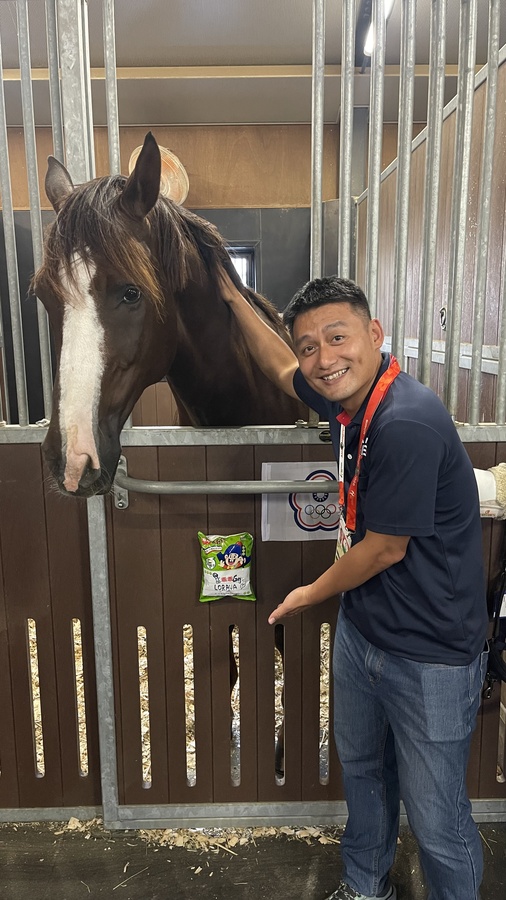
You do not expect to see a bright green bag of coconut-flavored puffed corn snacks taped directly to the stall door of an elite competition horse.
Yet, outside the stall of Lorava, a horse ridden by Chinese Taipei athlete Louisa Yeh, that exact green bag is taped to the stable door.
It is not a midnight snack for the groom, nor is it a treat for the horse. It is a ritual.
The snack is called Kuai Kuai, a household name back home that translates literally to "be good" or "be nice."
For groom and coach Chen Cheng-hsin, known to the team as Nash, seeing the green wrapper taped outside the stable door is as essential as checking the horses' horseshoes.
“It is a blessing,” Nash explained, pointing to the packet. “Whether it is our machines, our factories, or our offices, whenever we worry that something will go wrong, we put this on it. Everything runs smoothly, and everything passes.”
The superstition follows a strict visual code.
Kuai Kuai comes in several flavors and colors, but only the green coconut-flavored bag is used for blessings.
In traffic and system logistics, green signifies a green light—smooth operations and zero errors.
Yellow or red bags are strictly forbidden around sensitive equipment or stables, as those colors symbolize warnings, stop signs and mechanical failures.
“When I was a child, Kuai Kuai was just a cookie we loved to eat,” Nash recalled. “It is a very old company. But over time, people realized the green one carries the strongest blessing.”
Originating decades ago as a simple children's snack, Kuai Kuai evolved into an iconic urban legend across the high-tech industry.
Engineers and server administrators routinely place green bags atop multi-million-dollar supercomputers, automated factory lines and medical equipment to ward off technical glitches.
At the Asian Games, that same logic has been extended from computer servers to living, breathing athletes.
If a green bag can keep an automated assembly line running without a breakdown, the team reasons, it can keep a horse healthy, calm and obedient during high-stakes competition.
The ritual also carries a personal touch.
The manufacturers of Kuai Kuai leave a blank white space on the front of the packaging, explicitly designed for users to write down their specific wishes.
On the bag taped outside Lorava’s stall, the team wrote the horse's name alongside handwritten wishes for top performance and victory.
Across the designated stables housing the Chinese Taipei delegation, similar green packets can be spotted taped to doors and equipment crates.
In an environment defined by rigid schedule pressures, strict drug testing and intense physical demands, the green bags offer something beyond standard preparations.
They bring a familiar piece of home into the stable block, blending a tongue-in-cheek pop culture tradition with a serious desire for safety and success.
For Nash and the rest of the crew, the logic remains simple and unquestioned.
“It just means be nice,” Nash said with a laugh. “Be nice, stay safe - and perform well.”