
By Rumaiza Norova
OCA Young Reporter from Tajikistan
Nagoya, Japan, September 19, 2026: Whenever I enter a place lined with the flags of different countries, I have a habit: I look for Tajikistan.
My eyes move from one flag to another, searching for three familiar stripes and the golden crown in the centre. At hotels, international institutions and events, sometimes I find it. Many times, I don’t.
Tonight, I knew I would.
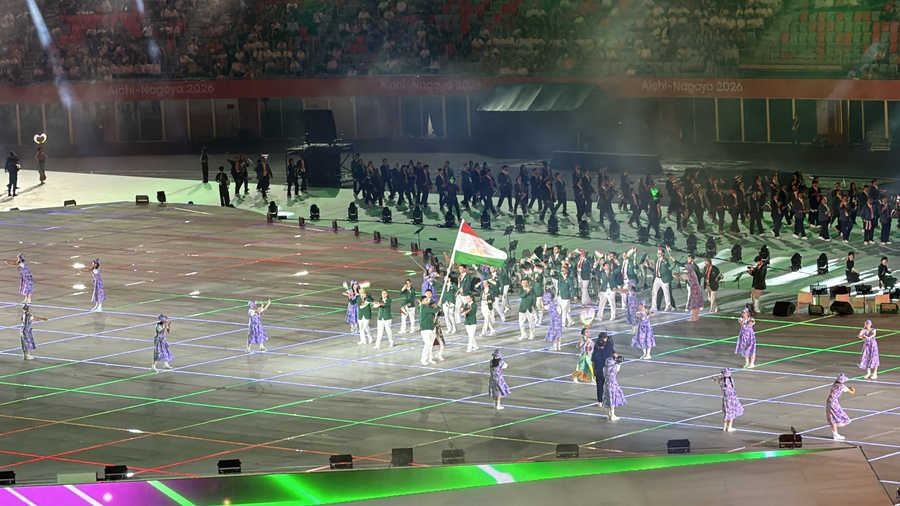
Before the athletes entered the stadium for the opening of the Asian Games, dancers moved across the field to the sound of a violin. The music rose through a stadium filled with thousands of people, followed by the raising of the flag and the anthem. Somewhere between the music and the silence that followed, the scale of what was happening began to feel different.
Soon, the flags started arriving.
One after another, delegations walked into the stadium. Every flag belonged to someone in the stands. Somewhere, someone had been waiting for it.
I knew the feeling.
When Tajikistan appeared, I wasn’t searching a row of flags anymore. I was watching our athletes carry one into a stadium before all of Asia. For countries that do not often occupy the centre of the world’s attention, there is something powerful about simply being seen: your country’s name announced, its athletes walking forward, its flag given its place among the others.
But what struck me was what happened between those moments.
People waited eagerly for their own countries, yet cheered when others appeared. Nobody had to surrender a flag, a language or an identity for the stadium to feel united. In fact, the differences were the entire point.
Earlier, listening to the violin, I had found myself thinking about how strange that felt against the world outside the stadium. Beyond it are wars, poverty and political divisions that sport cannot solve. Yet here were nations that disagree on much more consequential things sharing the same field, not because those differences had disappeared, but because for one evening they had something else to share.
“Imagine One Asia.”
The slogan of the Aichi-Nagoya Asian Games.
At first, “one” sounds like a word about sameness. Tonight looked nothing like sameness. It was dozens of uniforms, languages, anthems and flags.
Perhaps “one” does not mean asking any of them to disappear. Perhaps it means being able to search a stadium for your own flag, find it, and still cheer when someone else’s appears.
And perhaps that is why, by the end of the ceremony, I was no longer only looking for mine.