

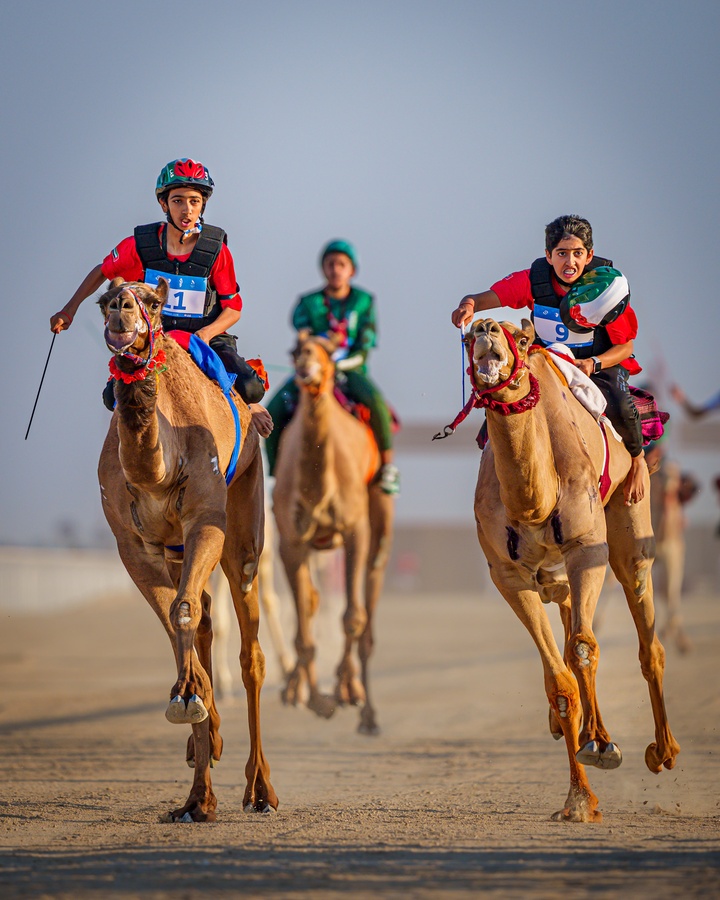
Manama, Bahrain, October 27, 2025: It took months of preparation for camel racing to make its debut at the Asian Youth Games, but it took only 45 seconds for each race to complete and for the United Arab Emirates to breeze to twin gold medals.
It was one-two for UAE in both the boys’ and girls’ races as the latest sport to enter the Games wowed a large crowd at the Equestrian Endurance Village in Bahrain on Monday, October 27.
Umair Al-Rashedi and Latifa Al-Ashkhair from the Emirates won the gold medals in the boys’ and girls’ races, respectively. Both finished the 500 metres race with identical times of 45 seconds. The silver medals were also won by Emiratis.
“We spent months preparing for this big day, for camel racing to make its debut on the Asian sporting scene, and it was all over in 45 seconds,” smiled Mohamed Ali Fadhel, camel racing competition manager.
A track had to be built, tailor-made for these games. Luckily Bahrain has enough desert space, and adjoining the more familiar horse venue, organisers carved out a kilometre-long track, straight as an arrow, with guard rails.
One of the biggest crowds at the games were on hand to witness history being made, and even before some of the latecomers could settle down and sip their Arabic coffee, the races were over in a flash.
In February this year, the OCA officially recognised World Camelids Sports as the official governing body of camel racing in Asia. This followed a request from the President of World Camelids Sports, Prince Fahd bin Jalawi bin Abdulaziz Al Saud.
Prince Jalawi, who is also the Vice President of the Saudi Olympic and Paralympic Committee, also officiated at the medal presentation ceremony.
Then in August, the OCA informed all Asian National Olympic Committees that as preparation for the Bahrain AYG, a two-week camel racing training camp would be held in Abu Dhabi.
A total of 11 countries entered athletes for the two races – 17 boys and eight girls – and all of them went to Abu Dhabi for training, and then flew right here for the competition. UAE and Saudi Arabia brought their own camels with them, the rest from places like Yemen, Mongolia, Uzbekistan, India, and Indonesia, depended on the organisers to mount them.
“The first time I got on a camel was when I went to Abu Dhabi for training. It is tough keeping your balance because you are so high up and you have to cope with a bouncy gait, but luckily I was somewhat accustomed as I take part in horseback archery back home,” said Indonesia’s Mohammad Al Fathih who finished 11th in the boys’ race.
At least he kept his seat unlike Amir Yehya from Lebanon who was unseated at the outset. “It can be hard, if you are not used to riding. And also you need to be strong to be able to control the camel,” Al Fathih added.

