






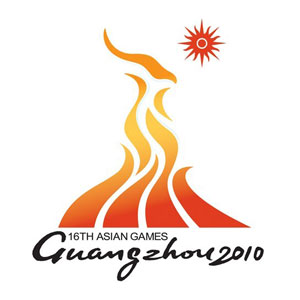
The design of the Games emblem is derived from a legend about the City of Guangzhou: As the legend goes, a long time ago, the farm lands in Guangzhou ran dry, food could not be grown and the people experienced a famine. They could do nothing but pray to the heavens for luck. Moved by their piety, Five Immortals descended from the sky, riding on goats with coats of different colors, each holding rice ears in its mouth. The Immortals gave the rice ears to the people and declared that the land would be free from famine.
Afterwards, they disappeared into the sky. The five goats that were left behind turn into stone. From that time on, Guangzhou reaped a bumper harvest of grain every year and grew into one of the most prosperous cities in China.
For this reason Guangzhou is also known as the City of Goats or the City of Rice Ears.
The Statue of the Five Goats in Guangzhou's Yue Xiu Park is a reminder of this legend and has, over the years, become the symbol of the city and one of its most well known landmarks.
The beloved goat is embodied in the emblem design, representing Guangzhou its people and their readiness to embrace the 2010 Asian Games and present the best of the city to people across Asia and the world.
The soft and uplifting lines in the emblem design outlines a contour of the Five Goats that is identical to the shape of a torch. The design of the emblem, a combination of the concrete and the abstract, of grace and ease, manifests the ever-burning sacred flame of the Asian Games. The emblem represents a perfect symbol of Guangzhou, the best wishes of its people, and the dynamics of the Asian Games.
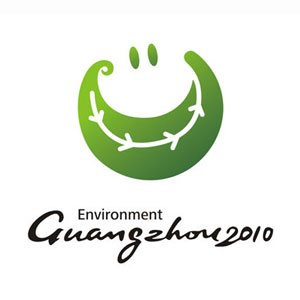
The Logo for the Environment is a green leaf in the shape of a smile that irrevocably connects Man and Heaven.
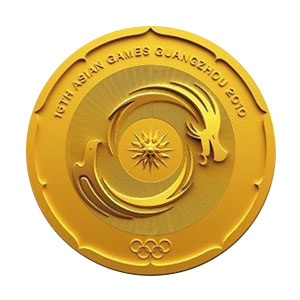
The gold, silver and bronze medals are themed Haishang Silu, or "Maritime Silk Road".
The face of the medals features the Emblem of the Olympic Council of Asian and Guangzhou's kapok flower which are fused together as an organic whole. The two are circled by a dancing dragon and a dancing eagle, vividly carved above the five Olympic rings.
The back of the medals features the Guangzhou 2010 Emblem and a boat on the sea. Guangzhou, the starting place of Maritime Silk Road, has been an important commercial centre and port in South China and a window linking China and the world since ancient times. More recently, it is known as the forefront of China's reform and opening up. The whole picture showcases Guangzhou's time-honoured history and pioneer spirit. The design of the back highlights traditional Chinese culture with waves in auspicious pattern.
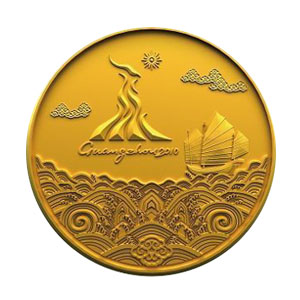
The gold, silver and bronze medals are themed Haishang Silu, or "Maritime Silk Road".
The face of the medals features the Emblem of the Olympic Council of Asian and Guangzhou's kapok flower which are fused together as an organic whole. The two are circled by a dancing dragon and a dancing eagle, vividly carved above the five Olympic rings.
The back of the medals features the Guangzhou 2010 Emblem and a boat on the sea. Guangzhou, the starting place of Maritime Silk Road, has been an important commercial centre and port in South China and a window linking China and the world since ancient times. More recently, it is known as the forefront of China's reform and opening up. The whole picture showcases Guangzhou's time-honoured history and pioneer spirit. The design of the back highlights traditional Chinese culture with waves in auspicious pattern.
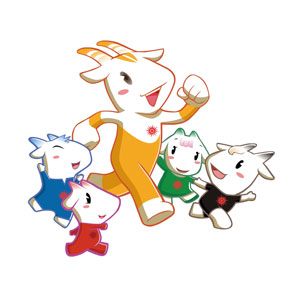
“Le Yangyang” is name of the leader of our five Goats and the name which refers to all of the 16th Asian Games Mascots, each of them sporty and cute, and each serving as an Official Mascot. The Mascots embody a part of Guangzhou’s unique history and culture and each Goat has an individual name that is distinctly Cantonese in style: A Xiang, A He, A Ru, A Yi and Le Yangyang.
When you put their names together, Xiang He Ru Yi Le Yangyang - meaning Peace, Harmony and Great Happiness, with everything going as you wish - they fully express the people of Guangzhou’s hope that the 16th Asian Games bring peace, prosperity, success and happiness to the people of Asia and fulfill their, and our, Vision of a “Thrilling Games and Harmonious Asia”.
The designs of the Mascots are strongly inspired by a legend about the City of Guangzhou: As the legend goes: A long time ago, the farm lands in Guangzhou ran dry, food could not be grown and the people experienced a famine. They could do nothing but pray to the heavens for luck.
Moved by their piety, Five Immortals descended from the heavens, riding on goats with coats of different colors, each holding ears of rice in its mouth. The Immortals gave the rice ears to the people of Guangzhou and promised that the land would be “free from famine”.
Afterwards, the Immortals disappeared into the sky. The Five Goats that were left behind turned into stone. From that time onwards, Guangzhou reaped a bumper harvest of grain every year and became the most prosperous city in the south of China. The Five Goats of this thousand-year-old legend have gone on become the most well-known symbol of Guangzhou.
The goat is also considered an auspicious animal that brings luck, in other Asian cultures. Through our choice of a goat, we sincerely believe our Mascots will appeal to, and resonate with, people of different cultures and religions throughout Asia, who we hope will grow to love them as much as we do.
The Slogan of the 16th Asian Games, a “Thrilling Games, Harmonious Asia”, is a dream and a promise, that the Games will uphold the spirit of the Olympics and the Asian Games – which is to promote unity, friendship and further exchanges between different countries and regions. The core goal of the Asian Games is to build a harmonious Asia, an Asia which transcends differences in race, nationality, religious beliefs and language. It is hoped that the hosting of a thrilling Asian Games will be another step on the road towards this goal.
“Thrilling” Games
The Guangzhou Asian Games will create an atmosphere where athletes from around Asia can excel, and achieve the Olympic ideals of “Faster, Higher, Stronger”, in a competitive, thriving and thrilling sports environment highlighted by intense competition.
“Harmonious” Asia
The Guangzhou Asian Games will uphold the Olympic values of “Unity, Peace and Friendship”, by promoting friendly exchanges and affection among the Asian people and boost the peaceful development of the entire region.
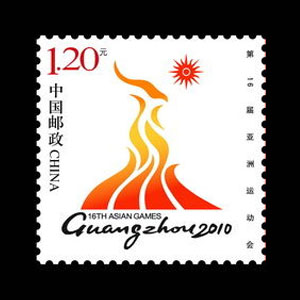
Stamps featuring the Emblem of the 16th Asian Games made debut on Friday. Issued by China Post, the 16th Asian Games Emblem Stamp is now available throughout the country. With a denomination of RMB1.20, the postage stamp has a tab bearing Guangzhou 2010 Vision "Thrilling Games, Harmonious Asia". A sheet, 210 x 180 mm in size, contains 15 stamps.
The stamp is made with the technique of offset printing, using anti-counterfeiting paper and ink.
Meanwhile, China Post issued a first day cover of the stamp.
China Post had previously issued personalised stamps for the Beijing 2008 Olympics.



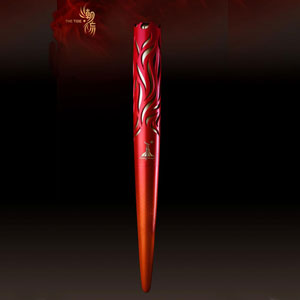
"The Tide" is tall and straight in terms of shape while dynamic in terms of image. The upper part of the exterior of the torch is pierced with Guangzhou's delicate ivory carving techniques. The pierced part looks like rising and flowing flames, highlighting vitality and passion; the solid part looks like flowing water, symbolising spirits of the Lingnan culture such as inclusiveness and innovation. The spiral-shaped torch burner signifies the spread of the Asian Games Spirit. With two layers, "The Tide" looks sophisticated, mysterious and solemn. The exterior of the torch is in the distinctive reddish colour of the flower of bombax ceiba, the flower emblem of Guangzhou, embodying the power and passion of life. The interior is in the golden colour of rice ears, standing for the host city Guangzhou, which is known as the City of Rice Ears.
Weight: 980g
Length: 70cm
Material: inner layer - stainless steel; outer layer - aluminum alloy
Water, the Pearl River and the sea have nurtured the unique Lingnan culture. Fire and the sun have expelled darkness and barbarism and activated the development of human civilisation. Water and fire constituted the precious memory in the early stage of human civilisation. Water, representing harmony, and fire, representing passion, constitute the carrier of the sacred flame.
The overall style of "The Tide" is in line with the Emlem and Prictograms of the Games.

The Logo for the Asian Games Volunteers combines love and personal service. All the symbols - which are easy to be identified, remembered and used - embody the Games' Vision of "Thrilling Games, Harmonious Asia" and an inspiring combination of the Lingnan culture and international design styles.